Art and inefficiency
In the first millennium BC
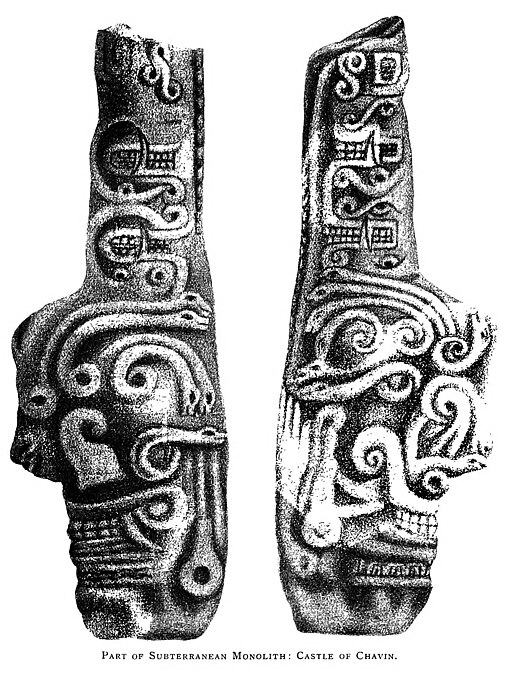
I have a feature in the latest issue of Archaeology about Chavín, a religion—or should we call it a cult—that spread through the Peruvian Andes starting around 800 BC. Much of the scholarly writing and thinking about Chavín (including a very evocative section in The Dawn of Everything) has focused on the temple complex of Chavín de Huántar, seemingly its primary religious center, and how the cult’s hierarchy and manipulation of psychedelic spiritual experiences may have helped define and entrench social inequality in the Andes. But I got more interested in different questions during my reporting: What did the practitioners of Chavín actually believe, and why was the religion compelling enough to catch fire and spread the way it did?
These are nearly impossible questions to answer about any ancient religion, but there are some brave scholars venturing hypotheses in the case of Chavín. I won’t spoil the whole thing, as the article is currently available to subscribers only1, but suffice it to say that the answers may lie in Chavín’s intricate, creative, and world historically unique art. In it, animals and humans assume one another’s features, predators become prey, beings appear to be simultaneously dead and alive, and the entire known world is woven together as time and space collapse.
Chavín art is confusing, disorienting, and overwhelming, which can make it a frustrating experience for those of us with modern eyes. Pieces of a sculpture seem to contradict the whole. Its meaning refuses to settle, and its images decline to coalesce into the kinds of characters or narratives those of us reared on texts expect to occupy a mythological world. Drawings or photographs of Chavín art don’t capture the experience of seeing it in its architectural context, which is often inside tiny, enclosed chambers. When I interviewed cultural anthropologist Mary Weismantel, she talked about how Chavín art demands a prolonged, full-body experience from its viewer, a kind of journey analogous to the pilgrimages people took to reach Chavín de Huántar itself.
The point of Chavín art was not prompt comprehension but extended engagement, and that may have been the case for the people making it, too. Weismantel told me that Andean artists, especially those working with textiles, seem to have developed techniques and practices that were purposefully time-consuming. Inefficiency wasn’t something to be avoided—it was what gave art its meaning.
Several translations of Apocalypse are on the way, including one in Spanish. Here’s my first Spanish-language interview about the book, on Milenio TV!
An annual digital subscription to Archaeology costs a very affordable $20! ↩


Add a comment: