How to tell a story
A book series to think with
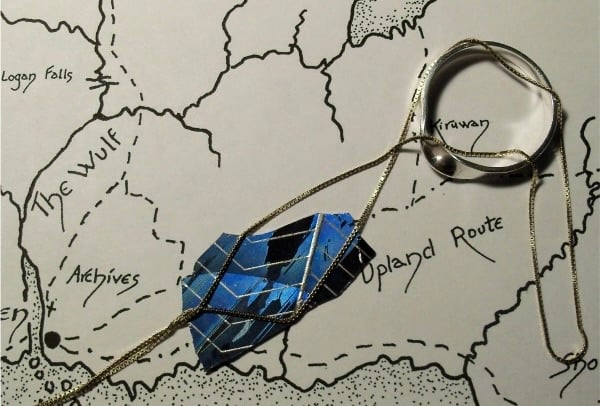
I recently blew through all four books in the Steerswoman series by Rosemary Kirstein, on a recommendation from mandy brown. Usually I don’t let myself do that, because I want to save something to look forward to. Sometimes my marshmallow-test tendencies serve me well; I cannot express the magnitude of relief I felt when I remembered, in March 2020, that I still had one Dublin Murder Squad book left to go. But I can’t imagine future me needing the Steerswoman books more than present me needed them, both for how they swept me away and gave my brain a break while I was traveling, reporting, and writing writing writing (two feature drafts in a month!), and for what they showed me about storytelling.
The main character of the series is Rowan, the steerswoman of the title, who spends her life figuring things out through research, travel, and conversation. She and her society’s other steerswomen are honor bound to truthfully answer any question, as long as the person asking it has always answered theirs. You might see why these books appealed to me.
I won’t say much more about the plot or the world, because the ideal experience is to go into the series cold. Only enough to set up a quote I couldn’t underline fast enough. Rowan has a friend named Bel, who comes from an oral, nomadic culture. In the second book, Bel composes an epic poem, and in the fourth, Rowan listens to her perform it for a new audience:
Rowan saw now that truly, this was the only way the story could be told. The information was intact, but participation in its unfolding made the knowledge each listener’s personal possession. (The Language of Power, 292)
That feeling of participation in the story is what makes the Steerswoman books themselves so compelling. In following Rowan as she figures things out, the reader also figures things out—sometimes the same things, often different ones. It’s hard to do as a writer, especially as a writer like me who’s been trained in explanation, context, and clarity. Those things are also hard, and they’re valuable in their own ways. But, at least for me as a reader, it’s “participation in [a story’s] unfolding” that creates a page-turner that sticks with you and keeps evolving after you put it down. (And it doesn’t need to be a book—I like how much the Steerswoman books value orality alongside literacy, something all those “end of reading” pieces could stand to think about more.)
Stories crafted to feel like “each listener’s personal possession” are also increasingly hard to come by. I know I’m not alone in feeling like the narrative arts I love have recently gotten stupider. Or more to the point, they seem to expect me to have gotten stupider. Streaming shows that restate the plot while it’s happening, books read like a checklist of tropes, movies that beat you over the head with their Important Themes (I’m looking at you, Christopher Nolan’s The Odyssey!). The viewer or reader has no room to breathe, think, or have their own ideas. I’m tired of art that doesn’t trust its audience, and I’m concerned that the few remaining gatekeepers seem determined we can’t and shouldn’t be trusted.
The Steerswoman series went out of print. Don’t let that stop you.
My writing
Every time ancient DNA researchers study burials associated with colonial epidemics in the Americas, they think they’re going to find smallpox. They never did—until now! For the first time, scientists have sequenced colonial smallpox genomes, from two mummies from northern Chile. Read my story for Science here.
Subscribe now


Add a comment: